
TerraTech Land Solutions
TerraTech Land Solutions is a new, family-run forestry mulching business owned by Jim and Roger Butler. They clear land with a forestry mulcher, which grinds brush, cedar and trees into mulch that stays on the ground, and they work within about 150 miles of Nevada, Missouri, across Missouri, Kansas, Oklahoma and Arkansas. I turned their logo concept into finished vector files, designed their business cards and built the website. Its quote form has a landowner draw around their property on a satellite map, and the form works out the acres. Under Google's throttled mobile test the homepage scores 100, against a median of 55 for Kansas City small-business sites.
The challenge
TerraTech was starting from zero. They had a painted concept for the logo and a domain with their email on it, but no website and no photos of their own jobs yet. The website also had a hard question to answer. A clearing job is priced mainly on how many acres there are, and Jim gives every price on-site once he's walked the property. Most people can't tell you how many acres their overgrown back pasture is, and a contact form that says "tell us about your project" gets back something like "about five acres of cedar, I think." The people asking are landowners, farmers and ranchers, and a lot of them will be standing on the land with a phone and not much signal.
What I built
The quote form is four short steps, made for a phone. The first one opens a satellite map from the U.S. Geological Survey. The customer finds their place, taps Draw around the area and traces a loop around the land with a finger, and the form works out the acres from the outline. If the line crosses itself into a figure eight, the form catches it and asks for one loop. Then it asks what a mulching quote really turns on, in plain words. What needs clearing: cedar, brush, a fence line, the lanes on hunting land. How thick it is, from "You can walk through it" to "You can't get through." How big the biggest trees are, measured against your wrist and your thigh. And anything out there to watch for, like steep or wet ground, old wire in the brush, a septic system or a well, or trees they want to keep. They can add up to eight photos, which get shrunk on the phone before they upload, so a weak signal can still send them. If they get interrupted halfway, their answers are still there when they come back.
Every request is saved to a database first and only then emailed, so if an email ever fails, the request is still there. Jim gets the request with the photos attached or linked, plus a link that opens the outline the customer drew on the same satellite map. The shape rides along inside that link, so opening it doesn't store anything anywhere. The customer gets a confirmation of their own. The map pictures come through the site itself and get cached at Cloudflare, with a lower-detail copy underneath, so a slow tile never leaves a gray hole in somebody's pasture. On a phone the map stays closed until somebody opens it, so none of it loads with the page.
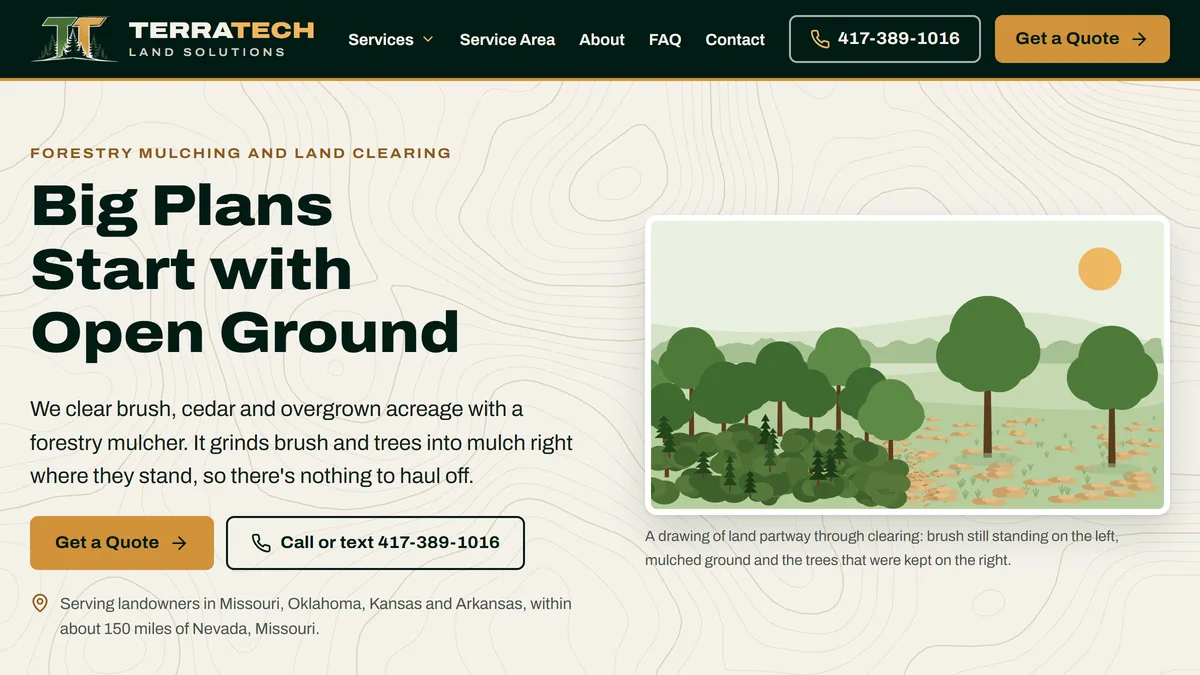
The rest of the site is written so a landowner can get a straight answer without calling. There's a page for each of their two services, a map of the towns inside their 150 miles split into five regions, and a guide to the federal and state cost-share programs that can pay part of the cost of clearing brush and cedar off farm and ranch land. Every fact in that guide links to the public page it came from, with the date it was checked, and it says plainly that you need approval before you clear. TerraTech didn't have job photos yet, so the before-and-after pictures are drawings, and the site labels them as drawings until real photos replace them. There are no prices anywhere on the site, because Jim prices every job on-site.
The brand came first. I redrew their painted concept as vector art, a main logo and a smaller one, in full color, black and white, in every file type a printer, sign shop or shirt shop asks for, with a guide to how small each one can go. Then came business cards for Jim and Roger and a set of images for Facebook and LinkedIn. All of it sits on a private page they can open on a phone to view, save or send any file.
The results
Under Google's throttled mobile test on 2026-11-05, the homepage scored a perfect 100 for performance, accessibility, SEO and best practices, with a 1.4-second Largest Contentful Paint, against a median mobile performance of 55 across the 105 Kansas City small-business sites I surveyed. Before launch, a checker I wrote read every page for broken links, missing alt text, long dashes and any claim the owners hadn't confirmed. To prove it works, it plants one problem for each thing it checks and has to catch every one, and it caught all 30. The domain moved from Squarespace to Cloudflare the afternoon the site went live, and their Google Workspace email kept working through the move, because every mail record was copied over and checked character for character first. The same day, the site went into Google Search Console and Bing Webmaster Tools with its sitemap submitted to both.
| Metric | TerraTech | Median KC site* |
|---|---|---|
| Mobile performance | 100 | 55 |
| Accessibility | 100 | 89 |
| SEO | 100 | 92 |
| Best practices | 100 | 96 |
| Indexable pages | 17 | - |
| Largest Contentful Paint | 1.4 s | 10.0 s |
Measured under Google's throttled mobile (Lighthouse) test on 2026-11-05. *Medians from my survey of 105 KC small-business websites. No CrUX real-user field data is available for this site, so every figure here is a lab measurement.
The stack, for the curious
No framework. A small Python build turns Markdown and YAML into static pages through Jinja templates, served from Cloudflare's network. The quote form's back end runs on Cloudflare Pages Functions: requests go into Cloudflare D1, photos go into R2, and the emails go out through Cloudflare's own email sending by way of a small Worker with no public address, so there's no third-party form or mail service in the middle. The maps are Leaflet over the USGS National Map's satellite imagery, fetched through the site's own tile route and cached for 30 days. Cloudflare Turnstile keeps bots off the form, the pages are served with a content security policy, and the domain is signed with DNSSEC. Every image, stylesheet and script is named after its contents, so a browser can keep it for a long time and never show a stale copy. Analytics are cookieless, through LiveDash.
Visit terratechlandsolutions.com ↗
Common questions
Who built TerraTech Land Solutions' site?
Adam Williams of 2k Web Developments, hand-coded from the first line, with no template, no page builder and no CMS behind it.
Who owns the site and the accounts?
The client does. Every line of code, the domain and every account are handed over at launch, with no strings.
How fast is TerraTech Land Solutions' site?
Under Google's throttled mobile test, measured 2026-11-05, it scores 100 for performance, 100 for accessibility, 100 for SEO and 100 for best practices, with a 1.4-second Largest Contentful Paint. The median Kansas City small-business site in my 105-site survey scores 55.
How big is the site?
17 indexable pages, every one hand-built.
What happens after launch?
Updates are a text to the person who wrote the code, not a support ticket. Ongoing care and hosting is available and starts at $49/mo.
Want a site that loads instantly and does real work, like this one?
Get a free quoteSee my custom toolsSee what I do for businesses in Nevada, MO.